Discovering Black Holes and Neutron Stars with LIGO
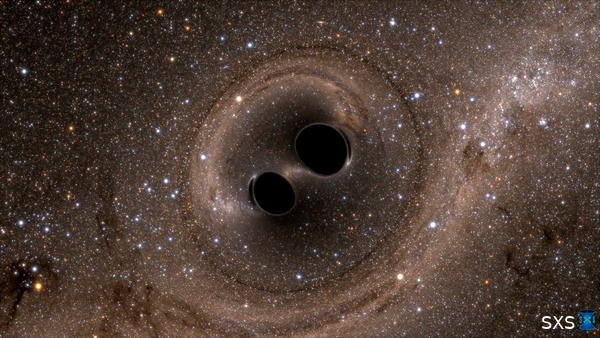
This project aims to advance the knowledge of the universe through gravitational--wave astronomy. Unlike conventional astronomy which relies on light from distant astronomical sources, gravitational wave astronomy measures tiny ripples in the fabric of space itself caused by massive objects such as black holes. A black hole's strong gravity prevents even light from escaping its grasp, and consequently, gravitational wave astronomy reveals the dark side of the universe by enabling the discovery of phenomena that were previously invisible. This new field began in 2015 when the NSF-funded LIGO observatory detected two black holes crashing together a billion light years away and has since opened a new window on the universe with more than a dozen confirmed cosmic collisions. Discovering the tiny ripples of a black hole collision billions of light years away requires sophisticated data analysis. This award funds analysis of LIGO data with the direct goal of detecting hundreds of new black holes and neutron stars in the next three years. These new discoveries will help to reveal how stars are born, how they die, and if the universe has anything hidden in its dark side.
The work proposed here furthers the mission of the LIGO Scientific Collaboration which is focused on the direct detection of gravitational waves, using them to explore the fundamental physics of gravity, and developing the emerging field of gravitational wave science as a tool of astronomical discovery. The award will deliver analysis of LIGO data over the next three years resulting in the detection of binary neutron stars, neutron star / black hole binaries and binary black holes. These new gravitational wave detections will comprise the deepest gravitational wave transient catalog to date with potentially hundreds of new discoveries occurring during the period of the proposed work. Each new compact binary merger will provide a new test of General Relativity, and in-aggregate, the discoveries will provide a precise assessment of the population of compact objects in the nearby universe. From this population it may be possible to infer the formation mechanism of the detected binaries and in doing so reveal details about their creation and evolution. With all gravitational wave discoveries, there is an opportunity to observe an electromagnetic or neutrino counterpart. New discoveries of binary neutron star mergers with optical counterparts like GW170817 will, among other things, deepen the understanding of heavy element production as well as to pin down the expansion rate of the universe. The proposed research has substantial inherent opportunities for public engagement as black holes are often met by a captivated audience. The personnel on this proposal are committed to making a direct impact through hosting a gravitational wave summer camp in central Pennsylvania. This camp will attract a diverse group of high school students who will have an opportunity to engage with Penn State researchers and learn about gravitational wave physics and astronomy. They will also learn about the role of high performance computing in scientific discovery.
Amount: $559,167
Selected publications
- R Abbott; TD Abbott; S Abraham; F Acernese; K Ackley; A Adams; C Adams; RX Adhikari; VB Adya; C Affeldt; others — GWTC-2: compact binary coalescences observed by LIGO and Virgo during the first half of the third observing run , Physical Review X (2021)
- R Abbott; TD Abbott; F Acernese; K Ackley; C Adams; N Adhikari; RX Adhikari; VB Adya; C Affeldt; D Agarwal; others — Gwtc-2.1: Deep extended catalog of compact binary coalescences observed by ligo and virgo during the first half of the third observing run , arXiv preprint arXiv:2108.01045 (2021)
- R Abbott; TD Abbott; F Acernese; K Ackley; C Adams; N Adhikari; RX Adhikari; VB Adya; C Affeldt; D Agarwal; others — GWTC-3: Compact binary coalescences observed by LIGO and Virgo during the second part of the third observing run , arXiv preprint arXiv:2111.03606 (2021)
- R Abbott; TD Abbott; S Abraham; F Acernese; K Ackley; A Adams; C Adams; RX Adhikari; VB Adya; C Affeldt; others — Observation of gravitational waves from two neutron star--black hole coalescences , The Astrophysical Journal Letters (2021)
- Rich Abbott; TD Abbott; S Abraham; F Acernese; K Ackley; A Adams; C Adams; RX Adhikari; VB Adya; C Affeldt; others — Population properties of compact objects from the second LIGO--Virgo Gravitational-Wave Transient Catalog , The Astrophysical journal letters (2021)
- Rich Abbott; TD Abbott; F Acernese; K Ackley; C Adams; N Adhikari; RX Adhikari; VB Adya; C Affeldt; D Agarwal; others — Search for intermediate mass black hole binaries in the third observing run of Advanced LIGO and Advanced Virgo , arXiv preprint arXiv:2105.15120 (2021)
- R Abbott; TD Abbott; F Acernese; K Ackley; C Adams; N Adhikari; RX Adhikari; VB Adya; C Affeldt; D Agarwal; others — Search for subsolar-mass binaries in the first half of Advanced LIGO and Virgo's third observing run , arXiv preprint arXiv:2109.12197 (2021)
- Chad Hanna; Prathamesh Joshi; Rachael Huxford; Kipp Cannon; Sarah Caudill; Chiwai Chan; Bryce Cousins; Jolien DE Creighton; Becca Ewing; Miguel Fernandez; others — Metric Assisted Stochastic Sampling (MASS) search for gravitational waves from binary black hole mergers , arXiv preprint arXiv:2110.15463 (2021)
- Debnandini Mukherjee; Sarah Caudill; Ryan Magee; Cody Messick; Stephen Privitera; Surabhi Sachdev; Kent Blackburn; Patrick Brady; Patrick Brockill; Kipp Cannon; others — Template bank for spinning compact binary mergers in the second observation run of Advanced LIGO and the first observation run of Advanced Virgo , Physical Review D (2021)


