Neil Gehrels Swift Observatory
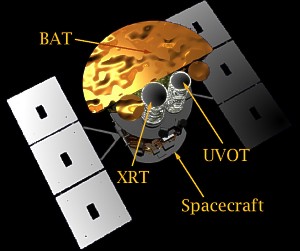
Gamma-ray bursts are fleeting events, lasting only a few milliseconds to a few minutes, never to appear in the same spot again. They occur from our vantage point about once a day. Some bursts appear to be from massive star explosions that form black holes.
The Swift observatory comprises three telescopes, which work in tandem to provide rapid identification and multi-wavelength follow-up of GRBs and their afterglows. Within 20 to 75 seconds of a detected GRB, the observatory will rotate autonomously, so the onboard X-ray and optical telescopes can view the burst. The afterglows will be monitored over their durations, and the data will be rapidly released to the public.
The X-ray Telescope (XRT) and the UV/Optical Telescope (UVOT) were built by Penn State and collaborators at Leicester University and the Mullard Space Science Laboratory (both in England) and at the Osservatorio Astronomico di Brera (in Italy). In addition, Penn State is responsible leads Mission Operations Center, which operates the satellite. [Text and image from https://www.swift.psu.edu/ and https://www.nasa.gov/mission_pages/swift/main]
| Photo | Name | Role | Affiliations | Phone | Office | Centers | Research topics | |
|---|---|---|---|---|---|---|---|---|

|
James DeLaunay | Faculty | Astronomy | jjd330@psu.edu | +1 814 865 6834 | 520 Davey Laboratory | CMA | |

|
Abe Falcone | Faculty | Astronomy | adf15@psu.edu | +1 814 863 5364 | 516 Davey Laboratory | CMA | Cosmic Rays, Multimessenger Astrophysics, Quasars, Dynamic Universe |

|
Derek Fox | Faculty | Astronomy | dbf11@psu.edu | +1 814 863 4989 | 425 Davey Laboratory | CMA, CTOC | Multimessenger Astrophysics, Neutrinos, Dynamic Universe |

|
Caryl Gronwall | Faculty | Astronomy | cag18@psu.edu | +1 814 865 2918 | 417B Davey Laboratory | CMA, CTOC | Astrostatistics, Cosmic Surveys |

|
Kyle Neumann | Graduate Student | Astronomy | kdn5172@psu.edu | (814) 865-0418 | 537 Davey Laboratory | IGC | Black Holes, Gravitational Waves, Multimessenger Astrophysics, Dynamic Universe |
| Photo | Name | Role | Affiliations | Phone | Office | Centers | Research topics | |
|---|---|---|---|---|---|---|---|---|

|
Samuele Ronchini | Postdoc | Astronomy | sjs8171@psu.edu | 8148657705 | IV Building | CMA, IGC | Gravitational Waves, Multimessenger Astrophysics |
