Project 8 Experiment
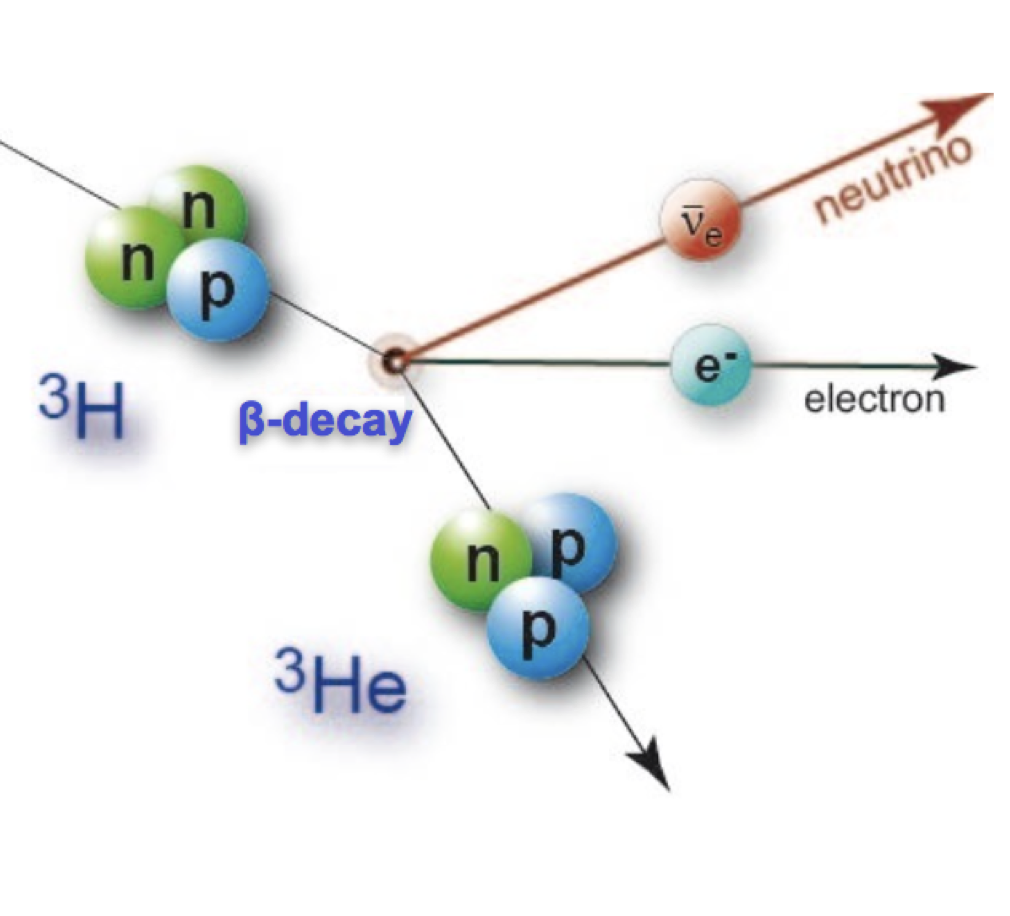
The goal of Project 8 is to measure the mass of the neutrino, which is a fundamental particle (that is, a basic building block of the universe). Neutrinos are incredibly abundant - for every atom in the universe, there are about a billion neutrinos. However, our experience with them is minimal because they barely interact with ordinary matter. In fact, trillions of neutrinos produced by nuclear processes in the sun pass through your body every second, like tiny ghosts.
Instead of trying to capture the neutrino itself, we look at the decay of tritium, which is an isotope of hydrogen. Tritium undergoes beta decay, emitting an electron and a neutrino which have to share the energy released in the decay. Using a new method based radio-frequency detection, we measure the energy of the electron very precisely. Whatever is "missing" must belong to the neutrino. For the highest electron energies, the missing energy amounts to the neutrino's mass. [Text and image from https://www.project8.org/]
| Photo | Name | Role | Affiliations | Phone | Office | Centers | Research topics | |
|---|---|---|---|---|---|---|---|---|

|
Srinikitha Bhagvati | Graduate Student | Physics | skb6413@psu.edu | 108 Osmond Laboratory | CMA | Dark Matter | |

|
Carmen Carmona Benitez | Faculty | Physics | mzc267@psu.edu | +1 814 865 6476 | 320D Osmond Laboratory | CMA | Dark Matter, Neutrinos |

|
Salvatore Cordova | Staff | Physics | sac6821@psu.edu | 857891241 | NA Osmond Laboratory | IGC | |

|
Reagen Garcia | Graduate Student | Physics | rgarcia@psu.edu | --- | 114 Osmond Laboratory | CMA | Neutrinos |

|
Richard Mueller | Graduate Student | Physics | rjm6826@psu.edu | +1 814 865 7533 | 6E Osmond Laboratory | IGC | Neutrinos |

|
Andrew Ziegler | Graduate Student | Physics | ziegler@psu.edu | 6E Osmond Laboratory | CMA | Neutrinos | |

|
Luiz de Viveiros | Faculty | Physics | lad57@psu.edu | +1 814 865 7533 | 320E Osmond Laboratory | CMA | Dark Matter, Neutrinos |
