Collaboration

The Astrophysical Multimessenger Observatory Network
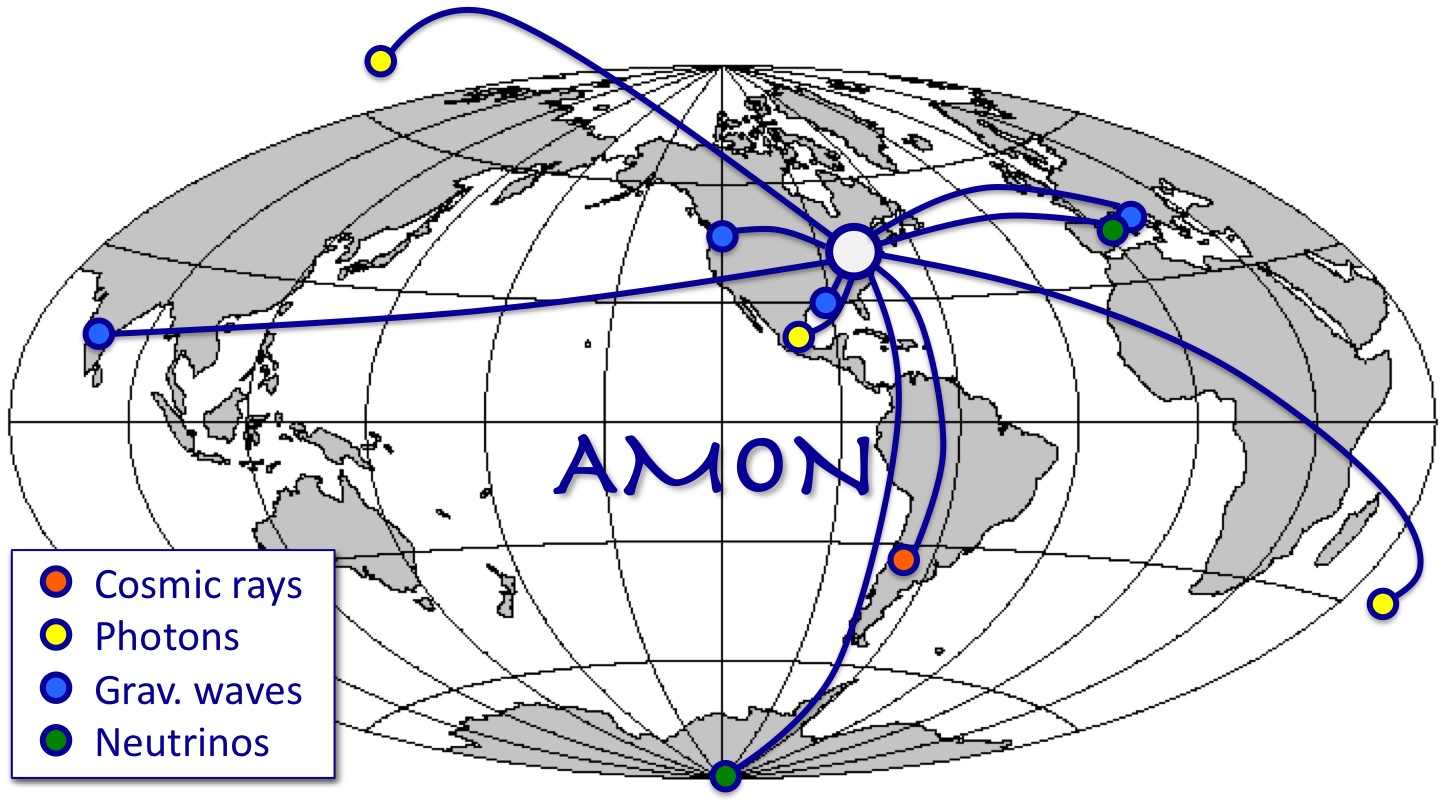
The Astrophysical Multimessenger Observatory Network

The Astrophysical Multimessenger Observatory Network (AMON) is a program currently under development at The Pennsylvania State University, in collaboration with a growing list of U.S. and international observatories. AMON seeks to perform a real-time correlation analysis of the high-energy signals across all known astronomical messengers – photons, neutrinos, cosmic rays, and gravitational waves – in an effort to: 1) Enhance the combined sensitivity of collaborating observatories to astrophysical transients by searching for coincidences in their sub-threshold data; and 2) Enable rapid follow-up imaging or archival analysis of the putative astrophysical sources. AMON participants can be characterized as “triggering,” “follow-up,” or both. Triggering participants are generally observatories that monitor a large portion of the sky and feed a stream of sub-threshold events into the AMON system. These events are processed to search for temporal and spatial correlations, leading to secondary “AMON alerts.” Follow-up participants generally search for electromagnetic counterparts to the AMON alerts with high-throughput, narrower field-of-view telescopes.

Visit the collaboration website

IGC members directory
Photo Name Role Affiliations Email Phone Office Centers Research topics
Hugo Alberto Ayala Solares Hugo Alberto Ayala Solares Faculty Physics hgayala@psu.edu +1 814 863 7533 206A Osmond Laboratory CMA, IGC Multimessenger Astrophysics
Stephane Coutu Stephane Coutu Faculty Astronomy, Physics sxc56@psu.edu +1 814 865 2015 303H Osmond Laboratory CMA Cosmic Rays, Multimessenger Astrophysics
Douglas Cowen Douglas Cowen Faculty Physics dfc13@psu.edu +1 814 863 5943 303D Osmond Laboratory CMA Multimessenger Astrophysics, Neutrinos, Dynamic Universe
Derek Fox Derek Fox Faculty Astronomy dbf11@psu.edu +1 814 863 4989 425 Davey Laboratory CMA, CTOC Multimessenger Astrophysics, Neutrinos, Dynamic Universe
Chad Hanna Chad Hanna Faculty Astronomy, ICDS, Physics crh184@psu.edu +1 814 865 2924 303 Whitmore Laboratory CMA Black Holes, Dark Matter, Gravitational Waves, Multimessenger Astrophysics
Kohta Murase Kohta Murase Faculty Astronomy, Physics kum26@psu.edu +1 814 863 9594 321B Osmond Laboratory CMA Cosmic Rays, Dark Matter, Gravitational Waves, Multimessenger Astrophysics, Neutrinos
Kara Whitaker Kara Whitaker Graduate Student Physics kbw5490@psu.edu 114 Osmond Laboratory IGC Cosmic Rays, Multimessenger Astrophysics
Stephanie Wissel Stephanie Wissel Faculty Astronomy, Physics wissel@psu.edu +1 814 863 9598 303B Osmond Laboratory CFT, CMA, CTOC Cosmic Rays, Multimessenger Astrophysics, Neutrinos
IGC members directory
Photo Name Role Affiliations Email Phone Office Centers Research topics
Bryce Cousins Bryce Cousins Staff ICDS, Physics bfc5288@psu.edu +1 814 863 9605 301 Whitmore Laboratory IGC Gravitational Waves, Multimessenger Astrophysics
Fe McBride Fe McBride Postdoc Astronomy Felicia.McBride@psu.edu +1 814 865 8484 417A Davey Laboratory CMA, IGC
Cody Messick Cody Messick Graduate Student Physics ccm188@psu.edu CMA Gravitational Waves, Multimessenger Astrophysics
Miguel Mostafa Miguel Mostafa Faculty Astronomy, Physics mam1264@psu.edu +1 814 863 8252 517 Whitmore Laboratory CMA Multimessenger Astrophysics
About our wordmark
Monica Rincon Ramirez

The IGC wordmark was created by Monica Rincon Ramirez while she was a graduate student at the Institute. Monica enjoys drawing new connections between fundamental theory and observations. Her graduate work included general relativity, loop quantum gravity, and quantum fields in cosmological backgrounds; her thesis focused on effective quantum corrections to gravitational phenomena from spinfoams and applications to cosmology. She received her PhD in 2024.

The wordmark symbolizes the scope of research at the IGC. The base represents quantum gravity, evoking the quantum geometrical picture from spinfoams and loop quantum gravity — approaches studied at the Center for Fundamental Theory. The middle shows galaxies embedded in a smooth surface characteristic of spacetime in general relativity and the larger physical scales studied at the Center for Theoretical and Observational Cosmology. The top curves to an extreme representing a supermassive black hole accompanied by an energetic jet, with a binary black hole pair nearby — the high-energy phenomena studied at the Center for Multimessenger Astrophysics.